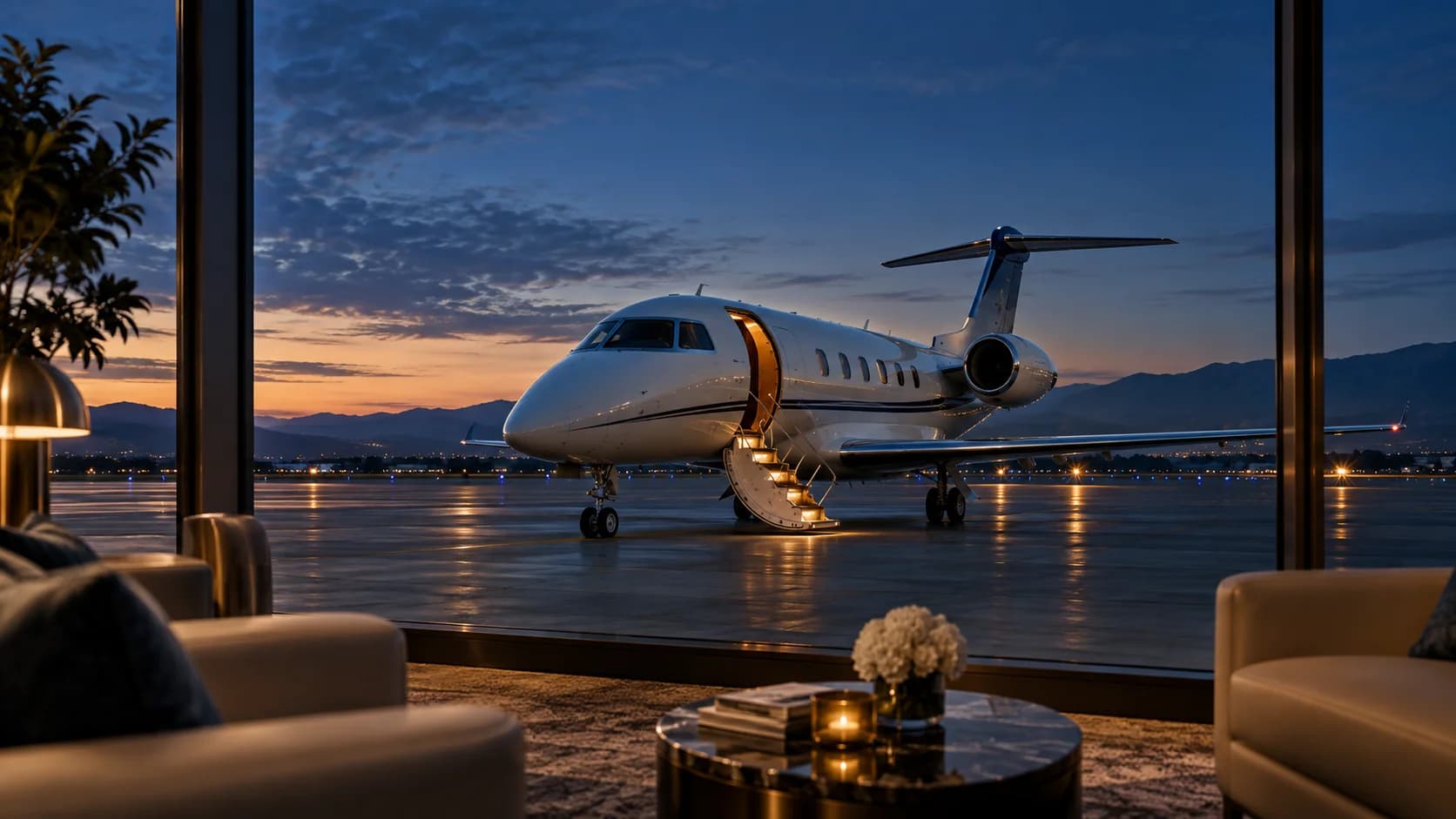
Two Products That Only Look Alike
First Class and private aviation get compared constantly and understood poorly, because they optimize for different things. A private jet sells control: your schedule, your airport, your manifest, wheels up twenty minutes after your car arrives. First Class sells the pinnacle of what a scheduled airline can deliver: a room in the sky, restaurant dining, showers at altitude, and the range to cross oceans, at a price that, per seat, is a fraction of charter.
The right question isn't which is better; it's which mission each wins. This piece puts real numbers on both, charter hourly rates by aircraft category against First Class fares by route, then maps where each dominates, what the semi-private middle tier actually offers, and the hybrid strategy that experienced travelers quietly use to get most of both for far less than full private.
What Private Charter Actually Costs
Charter pricing is hourly, by aircraft category, and the meter runs both ways, you pay for repositioning legs whether you're aboard or not. Light jets (Phenom 300, Citation CJ3) run roughly $6,000–$9,000 per hour and handle 3–4 hour hops for up to seven passengers. Midsize and super-midsize (Challenger 350, Citation Longitude) run $8,000–$12,000 per hour with transcontinental legs. Heavy jets (Gulfstream G550, Challenger 650) run $11,000–$16,000 per hour, and ultra-long-range flagships (G650ER, Global 7500) command $15,000–$18,000+ per hour with the range to fly New York–Tokyo nonstop.
Translate to trips: New York to Miami round trip on a light jet runs $35,000–$50,000. Coast-to-coast round trip on a super-midsize, $80,000–$110,000. New York to London round trip on an ultra-long-range jet, $130,000–$180,000. Add federal excise tax on domestic legs, international fees, catering, and de-icing in winter, and quotes swell 10–20% past the headline. Fractional shares and jet cards smooth the pricing but don't fundamentally change it: you're buying the airplane's time, and the airplane is the cost.
The Same Trips in First Class
Now run identical missions on scheduled flagships. New York to London in British Airways or American First: $9,000–$20,000 round trip published, and frequently $6,000–$9,000 in the negotiated market. New York to Dubai in Emirates First, with an enclosed suite, caviar, and the A380's shower spa: $15,000–$30,000 published. Los Angeles to Sydney in Qantas First: $18,000–$32,000. Even La Première, the most expensive First product per seat, tops out near $30,000, against $150,000+ to charter the same crossing.
The per-seat gap over oceans is a full order of magnitude, and the onboard product comparison isn't the sweep you'd assume. A chartered Gulfstream gives you privacy and control, but its galley serves reheated catering, there's no shower, the bed is a converted divan, and a two-person crew can't match a flagship First cabin's service depth. Over twelve hours of water, Emirates or Singapore Suites is genuinely the more comfortable way to fly, not just the cheaper one.
Where the Private Jet Wins Anyway
None of that math touches private aviation's real product, which is time and control. A jet leaves when you arrive, from an FBO where your car parks fifty feet from the stairs, no security line, no boarding process, no schedule. It serves the ten thousand airports airlines ignore: Aspen, Teterboro, Napa, the strip twenty minutes from the factory you're visiting. It turns a three-city day trip, impossible on any airline, into routine. And the manifest is yours: your team, your family, your dog, your conversation.
For missions shaped like that, short-haul, multi-stop, small-airport, time-critical, or genuinely private, First Class isn't a competitor, because no scheduled product can perform the mission at all. The honest framing: under roughly four hours of flight time with more than three travelers and a schedule that matters, private wins even at its price. Over eight hours of ocean with one or two travelers, it almost never does.
The Semi-Private Middle Tier
Between the two sits a tier worth knowing. Semi-private carriers like JSX and Aero sell single seats on 30-seat regional jets and configured executive shuttles flying from private terminals: walk up twenty minutes before departure, no terminal circus, $300–$1,500 per seat on routes like Burbank–Las Vegas, Dallas–Scottsdale, or LA–Cabo. It's the FBO experience at business-class-domestic prices, on a fixed schedule.
Above that, by-the-seat charter marketplaces and shuttle programs (XO and peers) sell individual seats on scheduled heavy-jet runs, New York to Florida is the classic, at $2,000–$4,000 a seat, and empty-leg repositioning flights offer whole aircraft at 25–50% of retail for travelers flexible enough to fly where the airplane already needs to go.
The limits are real: thin route maps concentrated on leisure corridors, schedules that are fixed rather than yours, and cabins that are comfortable rather than luxurious. But for the specific missions they fly, semi-private beats both First Class (which barely exists domestically) and full charter on value.
The Hybrid Play
The strategy that actually optimizes cost against experience is hybrid: fly scheduled First across the ocean, charter the short legs where private aviation is irreplaceable. A family heading from New York to a Provence summer flies La Première to Paris, $14,000–$25,000 a seat, with the lounge and tarmac transfer, then a $14,000 light-jet charter from Le Bourget to Avignon. Total cost lands under a quarter of chartering the Atlantic, and the onboard experience over the water is better, not worse.
The same template covers the Gulf (Emirates First to Dubai, charter onward to the Maldives), Asia (Suites or ANA First to the hub, charter to the island or the second city), and ski season (First to Zurich or Geneva, prop or helicopter transfer up the valley). Executed well, the connection is seamless: the charter waits on your landing, ground transfers bridge terminal to FBO, and delays rebook automatically.
The coordination is the hard part, separate operators, separate contracts, timing risk, which is precisely where a specialist earns a place in the transaction, holding both sides of the itinerary and the relationships behind the fares.
The Decision, By Mission
Reduce it to a table you can carry in your head. Short domestic hops with three-plus travelers and a real schedule: private or semi-private wins. Transcontinental with flexibility: First or top Business wins on value; charter wins only when time is genuinely worth five figures a day. Ocean crossings: flagship First wins on every axis but door-to-door privacy, and through negotiated fares it often costs less than a tenth of the charter quote. Complex multi-stop trips: hybrid.
The one mistake to avoid is category loyalty in either direction, chartering oceans out of habit burns six figures for a worse bed, and forcing airline schedules onto missions built for charter wastes the only asset that matters. Price both honestly per mission. A First Class travel specialist who works both markets can quote the scheduled and charter options side by side, which is the fastest way to see where your specific trip lands.
A specialist can price your route in one call, usually below anything published.
Frequently asked questions
How much does it cost to charter a private jet vs. flying First Class?
Charter runs $6,000–$18,000+ per flight hour by aircraft size, so New York–London round trip costs $130,000–$180,000 on an ultra-long-range jet, against $9,000–$20,000 published (often $6,000–$9,000 negotiated) per First Class seat on the same route. Per seat over an ocean, First Class costs roughly a tenth of private. Domestically under four hours, the gap narrows and charter's time savings can justify it.
Is a private jet more comfortable than First Class?
On long-haul, honestly, no. A flagship First suite gives you an enclosed room, a real bed, shower spas on Emirates' A380, and a crew serving a handful of passengers restaurant-grade food. A chartered Gulfstream counters with total privacy and your own schedule, but reheated catering, converted-divan beds, and no shower. Private wins the door-to-door experience; First wins the twelve hours in the air.
What are semi-private flights and are they worth it?
Semi-private carriers like JSX and Aero sell individual seats on small jets flying from private terminals, arrive 20 minutes out, skip the main terminal, pay roughly $300–$1,500 a seat on routes like Burbank–Vegas or LA–Cabo. For the corridors they serve, they're excellent value: most of the FBO experience at a fraction of charter cost. The catch is limited route maps and fixed schedules.
What's the smartest way to combine First Class and private charter?
Fly scheduled First across the ocean, then charter the final short hop, La Première to Paris and a light jet to Provence, or Emirates First to Dubai and a charter to the Maldives. You get flagship comfort where range matters and total schedule control where airlines don't fly, typically for under a quarter of chartering the whole journey. A specialist can coordinate both legs so the connection is seamless.