The Question Has Changed
Twenty years ago the case for First Class was simple: it had the flat beds. Then Business Class got flat beds, then direct aisle access, then doors, and the honest question became harder. When Qatar's Qsuite or a Delta One suite already gives you privacy and a proper sleep, what exactly does First sell?
The answer, on the airlines that still take First seriously, is everything sleep doesn't cover: double the personal space, restaurant-grade dining on your schedule, crews serving four passengers instead of forty, and a ground experience, private terminals, chauffeurs, escorted immigration, that begins hours before the aircraft door and continues after it.
Whether that's worth the premium depends on three variables this piece walks through: the actual product gap on your specific airline, the actual price gap on your specific dates, and what kind of trip you're taking.
The Hard Product: Space and Privacy
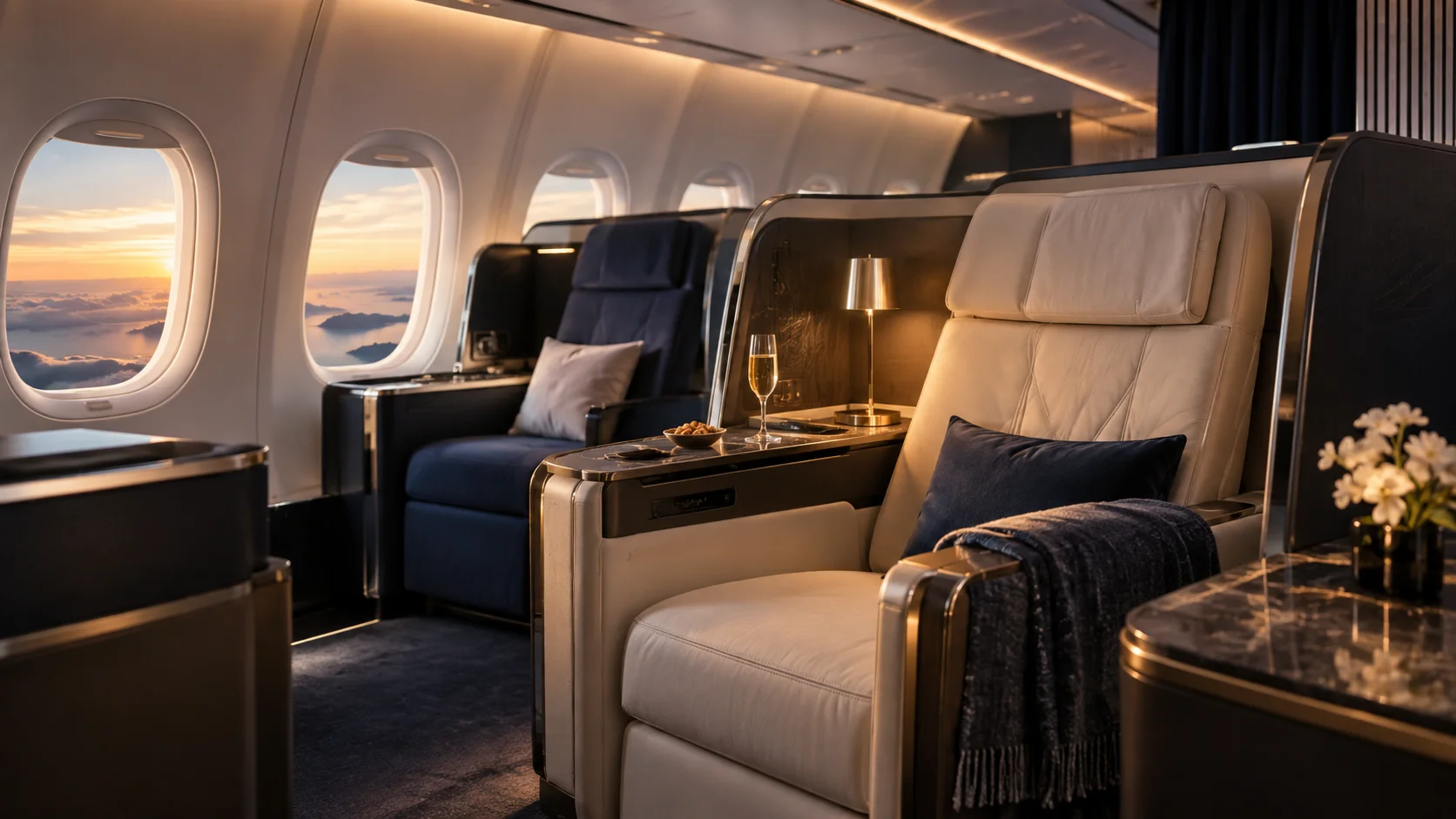
The physical gap is easy to quantify. A top-tier Business seat gives you roughly 21–23 inches of seat width and a pod you can't stretch sideways in; First suites on Emirates, Singapore, ANA, or JAL deliver 30–35 inches of seat width inside floor-space three to four times larger, with beds that let you turn over the way you do at home. Singapore's Suites add a separate bed and armchair; Lufthansa's Allegris Suite Plus encloses two seats in a private double room.
Privacy compounds the difference. Business cabins hold 40–70 passengers; First cabins hold four to fourteen. That ratio changes the sensory experience of the flight, galley noise, aisle traffic, meal-service clatter, in ways seat specifications don't capture.
The caveat cuts the other way, too: on carriers whose First is an older open seat, or whose Business is exceptional, the physical gap narrows to the point of vanishing. Qsuite Business is more private than several airlines' First.
Dining and Service: Where First Earns Its Keep Awake
Business Class dining is a good restaurant executing banquet service: fixed courses, trolley timing, competent wine. First Class dining is closer to a private chef: caviar service as a standing course on Emirates, Singapore, Cathay and JAL; kaiseki menus on ANA; Ducasse-designed plates on Air France; and dine-anytime flexibility as the default rather than the exception. The wine gap is starker still, Business pours solid champagne; First pours Krug, Dom Pérignon, Salon, and grand cru Burgundies.
Service ratios drive the intangibles. One crew member per three or four First passengers means your preferences are learned in the first hour, how you take coffee, when you want to be left alone. In Business, even excellent crews are executing a choreography; in First, they're hosting.
The Ground Experience: The Most Underrated Gap
On flagship carriers, the ground gap is categorical, not incremental. Lufthansa First passengers use a separate terminal in Frankfurt with private security and a driven transfer to the aircraft. Air France La Première passengers get a Ducasse-catered lounge and a tarmac chauffeur at CDG. Emirates First includes chauffeur service at both ends and a Dubai lounge floor that boards directly onto the aircraft.
Business Class lounges, even great ones, are shared spaces serving hundreds. The First tier is a different logistical reality: you can arrive later, move through immigration escorted, and land with a driver holding your name. For travelers who value time and friction more than champagne, this is frequently the part of First that justifies the fare.
It's also the part that varies most. US carriers and many European airlines offer First passengers little beyond the Business lounge, which is exactly why the worth-it verdict must be airline-specific.
The Price Gap, and the Unpublished Exception
Published pricing tells a discouraging story: international First typically lists at 1.5x to 3x the Business fare, $12,000–$30,000 round trip transatlantic or transpacific against $4,000–$9,000 for Business. At full retail spread, First is a luxury purchase, not a value one, and plenty of seasoned travelers rationally stop at Business.
The unpublished market rewrites the math. Consolidator and negotiated First fares sold through accredited specialist agencies routinely price 20–50% below published levels, which can compress the First-over-Business premium to 30–60% on the same flights. At that spread, the calculus flips for many travelers: double the space, the flagship lounge, and the chauffeur for a few thousand more, on a fourteen-hour flight, starts looking like the rational buy.
The disciplined approach: never evaluate 'is First worth it' against website prices alone. Get both cabins quoted in both markets for your actual dates, then decide.
The Fare Gap by Route: Real Numbers
Abstract multipliers hide how route-specific the decision is. Indicative negotiated bands from recent quotes, round trip per person, Business vs First on the same corridor, sampled September 2026:
- New York → London: Business from ~$3,500 vs First from ~$5,500, one of the narrowest gaps flying, because BA, AA, and JetBlue competition compresses both cabins.
- Boston → Zurich (SWISS): Business from ~$3,200 vs First from ~$6,500, SWISS sells both on the same aircraft, making this the cleanest like-for-like comparison.
- New York → Dubai (Emirates): Business from ~$4,500 vs First from ~$7,200, the First premium buys the shower spa, chauffeur, and enclosed suite.
- Los Angeles → Tokyo (ANA/JAL): Business from ~$5,000 vs First from ~$8,000, a daytime-heavy corridor where the First space is used awake.
- San Francisco → Singapore: Business from ~$4,800 nonstop vs First from ~$8,500 one-stop with Suites, here First also costs you a connection; decide if the cabin outweighs it.
- These bands move with season and load, treat them as the shape of the gap, and get both cabins quoted for your actual dates before deciding.
When First Is Worth It, and When It Isn't
First earns its premium in specific situations: flagship carriers where the product gap is categorical (Emirates, Singapore, ANA, JAL, Air France, Lufthansa, Cathay); daytime ultra-long-hauls where you'll be awake to use the space and dining; occasion travel where the journey is part of the celebration; travelers who prize the ground experience; and whenever an unpublished fare compresses the premium sharply.
It's not worth it when the airline's First is a marginal upgrade over an excellent Business suite; on short overnight flights where you'll board, sleep, and land; when the spread stays at full 2.5–3x retail and the money would visibly upgrade your hotels instead; or when First forces an inferior routing while a superior airline's Business flies nonstop.
The honest summary: Business Class is the smart default; First Class is a deliberate choice that's spectacular when the product and the price align. A First Class travel specialist can price both cabins across the unpublished market in minutes, which is the fastest way to find out whether your route is one where the choice tilts.
A specialist can price your route in one call, usually below anything published.
Frequently asked questions
How much more does First Class cost than Business Class?
At published fares, typically 1.5x to 3x, think $12,000–$30,000 round trip for international First against $4,000–$9,000 for Business on the same route. Unpublished and consolidator fares through specialist agencies frequently narrow that spread dramatically, sometimes to 30–60% over Business, which is when First becomes a genuinely rational purchase rather than pure indulgence.
Is First Class worth it on an overnight flight?
Less often than on daytime flights. If a flight departs at 10 p.m. and you sleep seven of eight hours, a flat Business bed captures most of the value, and the First premium buys space you're unconscious in. The exceptions: ultra-long-hauls where even a 'night' flight includes waking hours, and flagship routes where First's lounge and chauffeur benefits book-end the sleep.
Are Business and First Class converging?
The middle is converging; the top is escaping. Doors and privacy came to Business (Qsuite, Delta One, ANA's The Room), which killed weak First products, many airlines dropped First entirely. The survivors responded by going further up: Lufthansa's Suite Plus double cabin, Air France's five-window suite, Emirates' fully enclosed rooms. The gap between great Business and flagship First is wider than ever.
Which airlines have the biggest gap between Business and First?
Emirates, Air France, and Lufthansa show the largest experiential jumps, in each case the ground services (chauffeurs, private terminals or lounges) and cabin hardware change categorically. Singapore, ANA, JAL and Cathay follow closely, with the gap driven by suite size and dining. The smallest gaps are on carriers whose First is an older open seat barely distinguishable from their newest Business.